Why Moissanite is a Popular Option

Updated: Apr 14
SAY YES TO THE SPARKLE
Few industries have shaped cultural perception as powerfully as the diamond world.
Through its iconic 1947 campaign, the De Beers Group introduced a phrase that would forever alter the symbolism of love: “A Diamond is Forever,” written by Frances Gerety. With a single line, the diamond became more than a gemstone: it became a declaration of permanence, devotion, and status.
Over time, this message evolved into an unspoken equation — the greater the diamond, the greater the love.
But beyond narrative, there is truth in the material itself.
Ranking a perfect 10 on the Mohs scale of hardness, and whether natural or laboratory-grown, its durability ensures that it can be worn daily, passed down, and preserved as an heirloom. This means a diamond ring can endure levels of wear that few other gemstones can rival. By comparison, Corundum (known as ruby and sapphire) ranks at 9 on the Mohs scale, which might suggest a similar durability at first glance.
Yet, the Mohs scale is often misunderstood.
It is not linear, it is exponential.
A diamond’s hardness is approximately 3.5 to 4 times more resistant to scratching.
Between these two exists a fascinating intermediary — Moissanite.

AN ALIEN ALTERNATIVE
Scoring 9.5 on the Mohs scale, Moissanite occupies a unique position, both scientifically and symbolically.
Its origins are, quite literally, extraterrestrial.
First discovered in 1893 by Henri Moissan within the impact crater of Canyon Diablo, Moissanite was initially mistaken for diamond. It was only years later that it was correctly identified as silicon carbide; a compound distinct from diamond’s pure carbon structure.
Natural Moissanite is extraordinarily rare, found only in trace quantities within meteorites or deep-earth formations such as kimberlite. Its scarcity renders it virtually nonexistent in jewelry form.
As a result, all gem-quality Moissanite available today is laboratory-grown.

BRILLIANCE REDEFINED
What makes Moissanite so compelling is not just its origin, but its optical performance.
While diamonds are prized for their balance of brilliance and fire, Moissanite exceeds them in one specific metric: dispersion.
• Diamond dispersion: ~0.044
• Moissanite dispersion: ~0.104
This means Moissanite produces over twice the spectral fire. This appears like a vivid, prismatic display of rainbow light that is immediately recognizable to the trained eye.
Where a diamond emits controlled, refined flashes of white light, Moissanite offers something more expressive: a visible spectrum in motion. This is seen in the photo-example I added above from Taylor and Hart.
To the untrained eye, the resemblance is striking. To the professional, the distinction becomes a matter of nuance. This is observed through light behaviour, not just form.
With Moissanite sharing such an uncanny resemblance to Diamond (and at only a fraction of the cost) most people can now indulge in the appearance of adorning oneself with this luxury jewel.

Besides, natural Moissanite is GREEN.
In nature, the occurrence of silicon carbide is so negligible that new deposits found are highly sought after, but not for jewelry. The green shards shown above are from a recognized deposit found in Israel, and they are not the gem-quality expected in the designer industry. This finding was done in Mount Carmel area of northern Israel, with this crystal photography done by Aurélien Delaunay.
It is but the lab-grown colourless kind that makes its way into fine jewelry.
RARITY VS. ACCESSIBILITY
If laboratory-grown diamonds redefined accessibility within the diamond market, Moissanite extends it even further.
At a fraction of the cost, it allows for scale, presence, and design freedom that would otherwise be financially prohibitive. Larger stones, bolder settings, and experimental cuts become attainable, without compromising durability.
And yet, perception remains influenced by legacy narratives.
From Diamonds Are a Girl’s Best Friend to decades of cultural reinforcement, the diamond has long been positioned as the ultimate symbol of romantic value.
Moissanite challenges that narrative, not by imitation, but by offering an alternative expression of luxury.
A MATTER OF DISCERNMENT
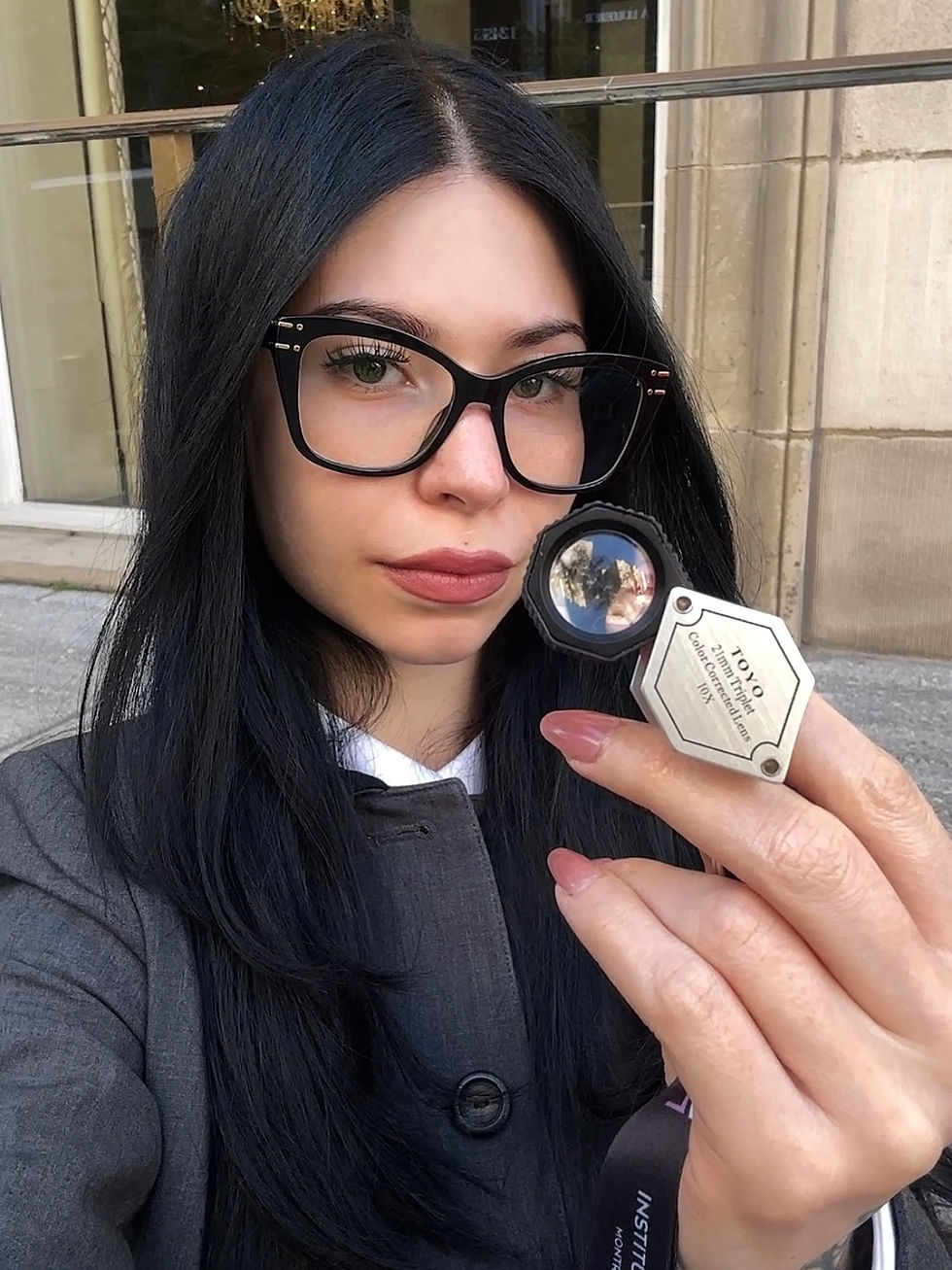
As a certified diamond grader, I can confidently say that distinction is learned.
Before formal training, the visual differences between diamond and Moissanite can be subtle. With experience, however, identification becomes immediate. This is done most notably through the observation of dispersion under magnification.
Moissanite’s brilliance is unmistakable. Not inferior. Not deceptive. Simply… different.
DESIGN WITHOUT LIMITATION
Today, the conversation is no longer about choosing between natural and laboratory-grown, or diamond versus alternative.
It is about alignment.
With your aesthetic. With your values.
With the way you define luxury and meaning.
Whether it is a diamond (formed over billions of years or engineered through human innovation) or a Moissanite born from the legacy of the cosmos, each stone carries its own narrative.
And each deserves to be chosen with intention.
Let’s create — If you are envisioning a custom piece, whether rooted in diamond, Moissanite, or beyond: I invite you into that process ↓
To brilliance in all its forms,
Evelina Bujor
FAQs
Q: How can I commission a custom piece?
A: You can connect with me directly via email, Instagram, Messenger on Facebook, and WhatsApp to begin gemstone sourcing for your project.


Comments