Natural vs. Lab-Grown Diamonds

Updated: Apr 14
THE TRUTH OF THE MARKET
One month after earning my diamond grading accreditation, I found myself confronting a reality I had not anticipated. A post-academia recalibration.
A market that, by all measurable indicators, should be expanding (rapidly and globally) felt, paradoxically, restrictive at the entry point.
In Montreal, conversations with established diamond companies revealed a consistent theme: the demand was not for graders, but for setters. Not for evaluation, but for assembly.
This disconnect becomes even more complex when considering the scale of laboratory-grown diamond production. With facilities, particularly across Asia, producing hundreds of thousands of carats monthly, the volume alone suggests an ecosystem that should require rigorous, ongoing evaluation.
And yet, the opposite appears to be unfolding.

A pivotal shift emerged with the announcement from the Gemological Institute of America. As of October 1, 2025, laboratory-grown diamonds would no longer be graded using the traditional 4Cs system. Instead, reports would be simplified into two classifications: standard or premium quality, alongside identification of growth method (CVD or HPHT).
But what happens to all the lab-grown diamonds in between?
At first glance, this may appear efficient.
In practice, it introduces a profound loss of nuance.
Where, then, does a finely balanced stone (an F colour, VS1 clarity, excellent cut, yet slightly lower polish or symmetry) exist within this binary framework? Collapsed into “standard”? Its individuality becomes diluted.
For a trained grader, this is not simplification.
It is erasure of detail.
SYNTHETIC DOES NOT MEAN “SIMULANT”
One of the most persistent misconceptions in the diamond space is the conflation of synthetic with “simulant”. Many natural diamond companies will push this to their advantage to perpetuate this mistake. They are not interchangeable.
Hence, many consumers will shy away from lab-grown diamonds because this confusing terminology convinces them of this: lab-grown diamonds must not be as good, or the quality differs since they are “fake”.
A laboratory-grown diamond is, in every chemical and structural sense, a diamond.
Its carbon atoms are arranged in the same cubic crystal lattice as its natural counterpart. The only distinction lies in its origin: one formed over billions of years beneath the Earth’s mantle, the other cultivated through advanced technological processes.
Simulants, by contrast, are materials designed to imitate appearance, not composition.
A prime example is Moissanite, whose heightened refractive index produces a brilliance and dispersion that, to the trained eye, diverges immediately from diamond.
Understanding this distinction is foundational.
Because once clarity is established, appreciation can follow.
ENGINEERING THE IMPOSSIBLE
Among the most extraordinary achievements in modern gemmology is the ability to replicate the conditions under which diamonds form.
Through High Pressure High Temperature (HPHT) processes, carbon is subjected to pressures exceeding 5 gigapascals and temperatures above 1200-1600°C — conditions that mirror those deep within the Earth.
The result is nothing short of remarkable.
HPHT-grown diamonds often crystallize in distinct cuboctahedral forms. These are geometries that reflect their controlled growth environment. These specimens are not inferior imitations; they are precision-engineered manifestations of natural law.
In 2022, Meylor Global produced a 150+ carat boron-doped blue Type IIb diamond using HPHT methods. This is an incredible achievement that stands as both scientific and aesthetic triumph.
Synthetic does not mean lesser.
It means intentional creation at the edge of human capability.

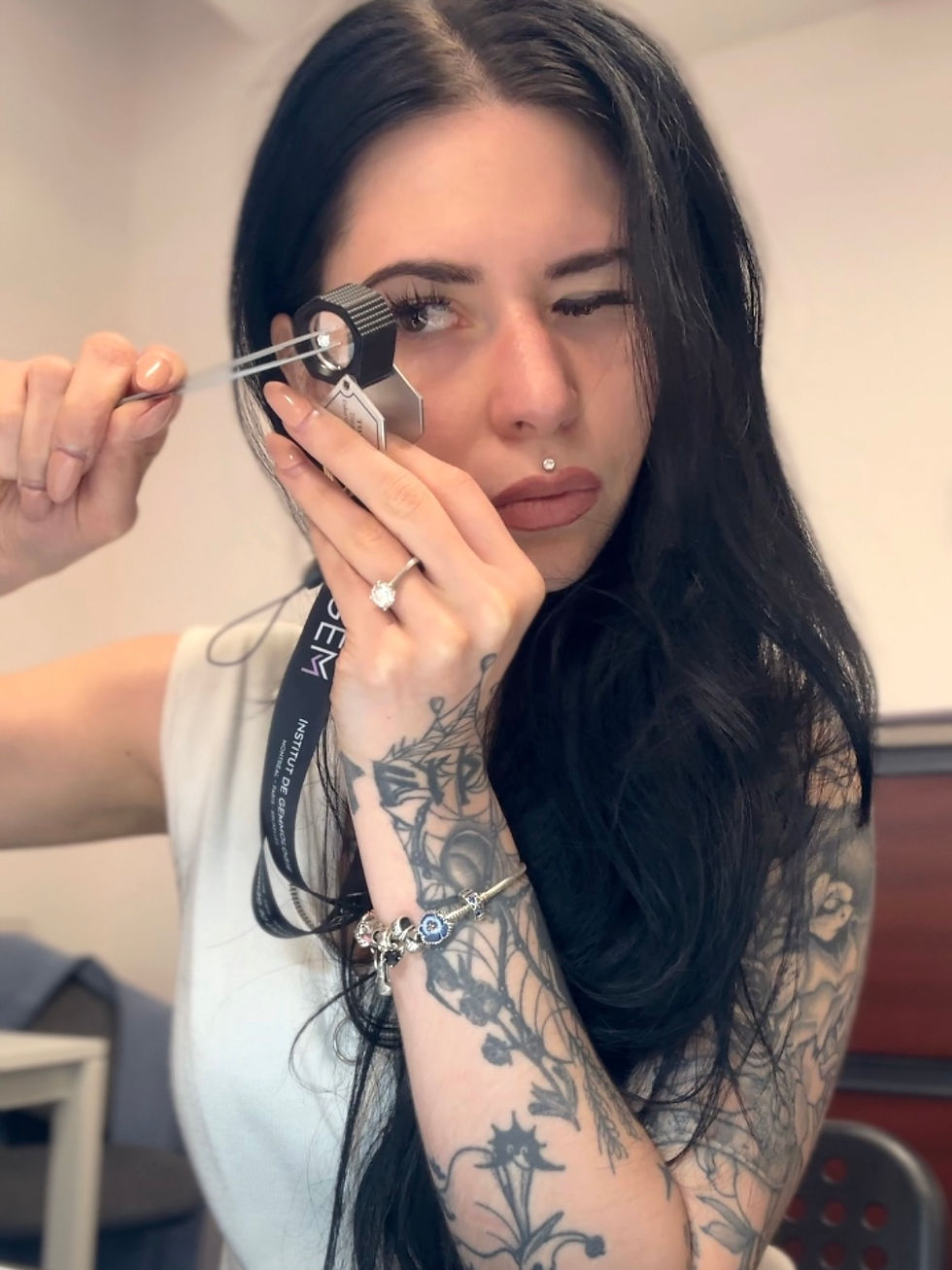
A blue Boron-doped HPHT-grown diamond under my microscope at the Gemological Institute of Montreal, c. July 2025.
If that doesn't completely take your breath away, I don't know what will.

These are just some examples of HPHT-grown diamonds (my 2.09 carat ring above and my 1 carat total earring pair below) — you wouldn't be able to tell them apart from a VVS natural diamond.
The only true points of distinction lie in fluorescence response (if any), and in the absence of naturally occurring features: such as indented naturals, knots, or mineral crystal inclusions that you will not find within HPHT-grown diamonds.

A MARKET SHAPED BY NARRATIVE
To understand the tension between natural and laboratory-grown diamonds, one must look beyond the stones themselves, and toward the narratives that surround them.
For decades, the natural diamond market has been shaped by legacy institutions such as the De Beers Group, whose influence extends far beyond mining. Their name seeps into branding, pricing psychology, and consumer perception.
Recent campaigns positioning lower-colour natural diamonds under evocative names, framing inherent colour as “earth-toned rarity”, highlight a strategic pivot: reframing limitation as desirability.
''Ombré Desert Diamonds'', reminiscent of their African mining roots, is a name playing on the imperfections of the natural diamond, and with this, placing them in a direct adversity position to lab-grown diamonds: “they are a poor colour (according to GIA D-Z standards) because they are natural”.

In post from Rapaport on LinkedIn (the pricing and news established entity of diamonds), there is a stipulation that organizations like CIBJO have explored restricting terminology around “laboratory-grown” diamonds. They are citing potential harm to natural diamond sales, which in turn, encourages the use of misleading ideas towards consumers around the ethical, and laboratory-grown diamonds industry (to save their own).

These movements are not isolated.
They are indicative of a broader effort to preserve hierarchy within a market undergoing rapid democratization.
Because the reality is this:
Laboratory-grown diamonds offer exceptional colour and clarity, often surpassing natural stones, at a fraction of the cost.
And in an economic climate where accessibility matters, this shift is not subtle. Imagine the modern middle class spending over $10,000 on a 1 carat natural diamond versus less than half for a lab-grown one. The widespread confusion between synthetic and simulant materials reflects a gap in consumer understanding. This is something that should be clarified, not compounded, by the very institutions and companies entrusted with guiding the industry.
THE DISPLACEMENT OF THE GRADER
Within this evolving landscape lies an unexpected consequence: the diminishing role of the independent diamond grader.
Independent graders are the ones who understand that transparency matters more than a sale.
If laboratory-grown diamonds are no longer evaluated with full 4Cs precision by leading institutions, their perceived “need” for grading diminishes in the eyes of the market.
Volume increases while nuance decreases.
And with it, the demand for expertise.
Simultaneously, retail environments often prioritize sales over specialization. These first line positions that do not require formal gemological training, despite the technical complexity of the product itself.
The result is a paradox:
A field that requires more knowledge than ever is creating fewer pathways for those trained to provide it.
TOWARD INDEPENDENT AUTHORITY
In many ways, this reality reframes the role of the modern diamond professional.
The future of diamonds will not be defined by natural versus laboratory-grown: it will be defined by informed discernment.
By the ability to look beyond origin and into structure, craftsmanship, and integrity. And by those willing to uphold precision, even when the industry begins to favor approximation.
It is no longer enough to be certified, one must be self-directed.
This is why I must:
• Build independent credibility
• Educate with clarity
• Provide transparency
As it is now clear that this is a space increasingly shaped by simplification and marketing.
Because while institutional frameworks may shift, the value of true, detailed evaluation does not disappear.
It simply finds new channels — The Diamond Frequency™ also on Instagram ↓
@ thediamondfrequency or my frequent vlogs here.
To more passionate writings ahead,
Evelina Bujor
FAQs
Q: Which laboratory still provides detailed reports for lab-grown diamonds?
A: The IGI (International Gemological Institute) remains one of the leading institutions offering comprehensive grading reports for laboratory-grown diamonds, including growth method identification and post-growth treatments.


Comments