The Many Facets of a Diamond Grader

Updated: Jul 22
FROM PASSION TO PURPOSE
There are milestones one reaches, and then there are moments that redefine self-perception entirely.
This is one of them.
The morning after receiving my official confirmation from the Montreal Institute of Gemmology, I sat with a feeling unfamiliar in its depth: completion. I had successfully passed my final diamond grading exam, graduating with consistent top results.
Not relief. Not validation. Embodied pride.
For someone who has always moved with exacting standards and relentless self-expectation, this achievement felt different. It was not external, it was cellular. A quiet, undeniable knowing that I had stepped into a level of precision and mastery I once only studied from afar.

WHERE CURIOSITY BECOMES DISCIPLINE
My path toward diamonds was never separate from my devotion to crystals: it was its natural evolution.
For years, I found myself drawn to the origin stories of Earth’s most powerful mineral formations. Diamonds, in particular, held a fascination that extended far beyond aesthetics. They represented time, pressure, and perfection under conditions most would not survive.
After repeatedly encountering the Institute’s presence at the annual Montreal Gem Show, I made the decision to formally enter the field.
What followed was not casual study, it was total immersion.
Balancing full-time work with the intensive program demanded a level of discipline that reshaped my daily life. Study sessions became omnipresent, woven into every available hour. I pursued knowledge beyond curriculum requirements, absorbing literature from leading authorities in gemmology, including publications by the Gemological Institute of America and the De Beers Group.
Twelve-hour study days became routine. Precision became instinct.
That devotion culminated in achieving the highest academic standing in my cohort.

BEYOND THE SURFACE OF A DIAMOND
What distinguishes a diamond professional is not admiration, but its understanding at the atomic level.
Here are a few of the most compelling insights refined through my studies:
✓ Diamonds are composed purely of carbon, yet the presence of nitrogen within their crystal lattice, introduced during formation, results in the subtle yellow to brown hues observed across the classic D–Z colour scale.
✓ Due to their atomic structure, diamonds possess the highest molar density of any naturally occurring material on Earth. This is a level of compactness only rivalled in extreme cosmic environments.
✓ Type IIa diamonds, devoid of measurable nitrogen, represent less than 2% of natural diamonds, yet are disproportionately replicated in laboratory-grown stones.
✓ Structural irregularities such as atomic vacancies and lattice distortions give rise to rare and highly coveted colours, including natural greens, pinks, and reds, each a direct imprint of geological history.
✓ Even within modern innovation, the evolution of synthetic diamonds into advanced HPHT and CVD technologies reveals a fascinating intersection between nature and human ingenuity.
Yet theory, no matter how rich, is only the beginning. My time at the laboratory was the revolutionary part.

LEARNING THE ROPES
The laboratory is where abstraction dissolves into reality and where knowledge becomes skill.
Over the course of an intensive, multi-day practical session, I entered a world defined by microscopic precision: long hours spent between microscope lenses and a 10x jeweller’s loupe, training the eye to detect what most would never perceive.
Each day unfolded as a test of endurance, focus, and technical control. This was not passive observation, it was active calibration of the senses.
Mastering clarity grading required the ability to identify and map inclusions across a spectrum ranging from VVS1 to I3. Diamond plotting, in particular, became one of the most rewarding disciplines, that of transforming invisible internal characteristics into structured, tangible representations.
Cut evaluation, however, proved to be the most demanding.
Assessing proportions, symmetry, and polish, without reliance on automated systems, requires a level of spatial awareness and objectivity that borders on surgical. Every measurement must be manually stabilized, observed, and averaged with absolute care.
It is a practice that demands stillness. And precision under pressure.

A STUDY IN LIGHT AND STRUCTURE
Perhaps the most breathtaking aspect of this journey was witnessing theoretical knowledge materialize in physical form.
Diamonds reveal themselves in layers.
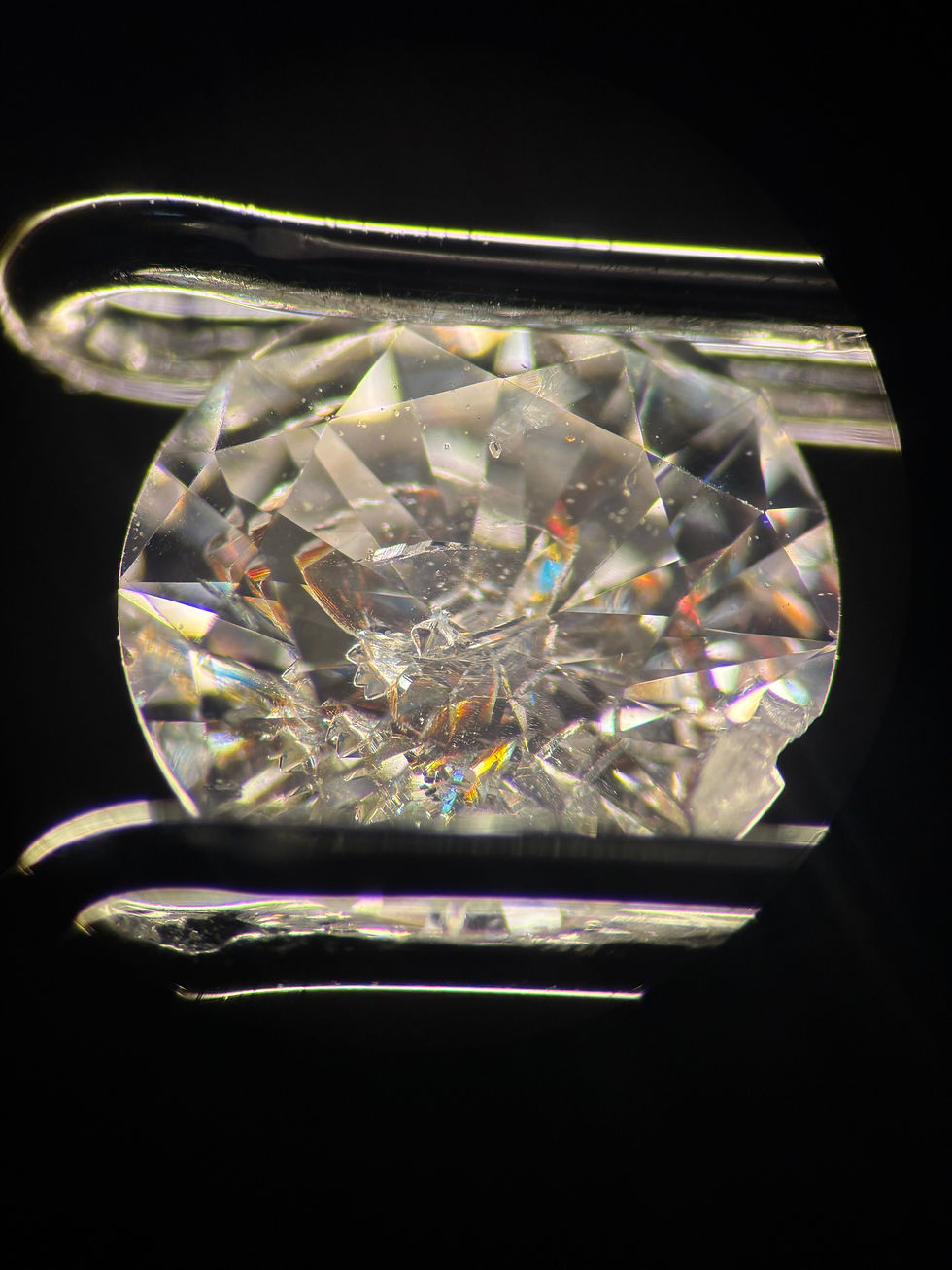
During one lab session, I encountered a specimen that perfectly embodied this complexity: a smaller natural octahedral diamond encapsulated within a larger round brilliant, forming what is known as a “crystal” inclusion.
A diamond within a diamond.
A moment suspended in geological time, unchanged for billions of years, now observed within the span of a single breath.
It is in these moments that gemmology transcends science: it becomes reverence.
A FOUNDATION FOR WHAT COMES NEXT
Earning an internationally recognized diamond grading diploma, supported by the World Gem Foundation, marks not an end — but a beginning.
This experience has refined not only my technical expertise, but my perspective on value, rarity, and discernment.
It has expanded the lens through which I curate, evaluate, and ultimately present each piece within my world.
And this is only the first facet.
To aligned beginnings,
Evelina Bujor

FAQs
Q: What is the rarest diamond colour?
A: Among naturally occurring fancy colours, purple diamonds are considered among the rarest. Historically sourced from the now-closed Argyle Mine, their formation remains one of the least understood phenomena in gemmology. Present sources are now perhaps limited to mines from the Yakutia and Arkhangelsk regions in Russia.
Q: What is the largest diamond ever discovered?
A: The Cullinan Diamond — it was unearthed in South Africa in 1905, weighed an extraordinary 3106 carats in its rough form before being cut into the famed “I-IX” Cullinan stones.


Comments